
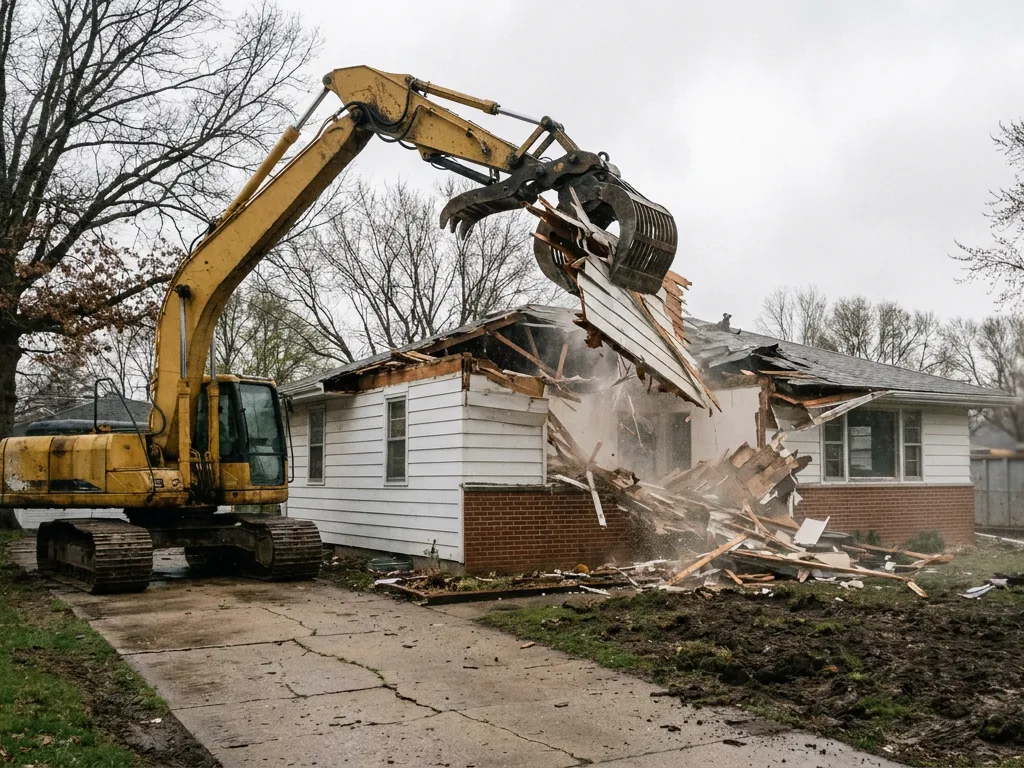
Whole-house teardowns
Independence Demolition Pros: House Demolition in Independence, Missouri
One-story, two-story and basement houses taken down, hauled out and left as a compacted, graded lot, with the City's permit, utility and asbestos steps in the right order.
- Independence and 10 towns within 20 miles
- Written price before any work starts
- City permit, utility and asbestos steps explained
- Local, licensed, insured contractors
Independence Demolition Pros connects Independence owners with local contractors for complete house demolition: the structure, the foundation, the driveway if you want it gone, and the grading that turns a lot back into usable ground. Most calls come from heirs settling an estate, landlords with a house past saving, owners holding a dangerous-building letter, and buyers clearing a lot to build new.
Pulling the house and dumping fill into the basement in one pour saves perhaps $1,000 on the day and leaves a soft pit that settles under the lawn or the next slab; re-excavating and compacting it properly later runs $5,000 or more.
What it costs
$10,000 to $21,100
The published range for demolishing a house in Kansas City, Missouri (HomeBlue, May 2024). A house under 4,000 square feet with no basement runs $10,000 to $12,600; the same house with a basement $12,100 to $15,800; a larger house with a basement $16,300 to $21,100. Asbestos found in testing is priced separately.
Calls answered Monday to Friday 7 a.m. to 6 p.m., Saturday 8 a.m. to 2 p.m.
Signs the house is a teardown, not a repair
What owners usually describe on the first call.
- Basement walls bowed inward or cracked in a stair-step pattern through the block
- A roof that has leaked long enough to rot the rafters and the ceiling joists
- Floors that slope enough to roll a marble, with doors that will not close
- Fire, smoke or storm damage that reached the framing
- A dangerous-building notice from the City of Independence
- Repair estimates that add up to more than the finished house would sell for
What a complete house demolition includes
A complete job is more than knocking the house over. The contractor files the permit with the site plan and the insurance certificate naming the City, confirms the water and electric meters are pulled, has Spire kill the gas and Municipal Services inspect the sewer kill, and places the silt fence before anything is touched. Then an excavator with a grapple takes the roof and walls down in sections and loads them into roll-off dumpsters or end-dump trucks, while a hose keeps the dust down.
After the frame is gone, the foundation comes out. Block and poured walls are broken with a hydraulic breaker or crushed with the bucket, footings are pulled, and the basement is filled with clean fill. The loess clays under Independence drain slowly and hold water, so the fill goes in lifts and gets compacted rather than dumped in one pour.
- Permit fee
- $200 to $600 by square footage (City of Independence)
- Insurance
- $100,000 / $300,000 / $100,000, City named as additional insured
- Utilities
- Water and electric meters pulled by the City; Spire for gas; Municipal Services for the sewer
- Asbestos
- Licensed inspector before demolition; MO DNR notice 10 working days ahead for regulated structures
Basement house or slab house
Most Independence houses from the 1950s and 1960s sit on full basements of block or poured concrete, which is why the local range runs above the national average. Those take longer and cost more: the walls have to come out or be broken below grade, and the hole takes several hundred cubic yards of fill. A slab or crawlspace house comes down faster and needs far less dirt. If you are not sure which you have, a photo of the foundation sent before the walk-through helps the contractor bring the right machine.
Ready for a written house demolition price?
Say where the house is, whether it has a basement, and when it was built. A local contractor walks the lot and puts the number, the permit and the asbestos step in writing.
Call (816) 846-2347Before the excavator arrives
Remove anything you want to keep, including fixtures you plan to sell. Tell the contractor about fuel tanks, septic tanks or wells on the property, since each has its own closure steps. If the house went up before about 1980, plan on the asbestos inspection: siding, floor tile, pipe wrap and joint compound are the usual places it turns up, and the asbestos page explains what happens when a sample comes back positive.
- The demolition permit application filed before any utility is disconnected, as the City checklist requires
- Erosion control placed before the meters come out, since Public Works inspects it with the sewer kill
- Neighbors told the date, since a teardown is loud for a day or two and the trucks need the street
Teardowns in the towns around Independence
Outside the city the steps are the same and the paperwork changes hands. A house in Blue Springs goes through Codes Administration on West Main; one in Lee's Summit needs the water and sewer abandoned under a right-of-way permit first; one in unincorporated Jackson County goes through Public Works on West Walnut. If the house was damaged by fire, see fire-damaged house demolition for how insurance and evidence holds change the schedule.
House Demolition available in
Frequently asked questions
What owners ask before a teardown
How much does it cost to tear down a house in Independence?
Published Kansas City figures run $10,000 to $21,100. A basement, asbestos, a long driveway or a tight lot pushes it up; a small slab house with good access comes in near the bottom.
How long does a house demolition take?
The demolition itself is usually one to three days for a single-family house. The permit, the utility verifications and the asbestos notice come first and often take longer than the teardown.
What are the signs a house should be demolished?
A failing foundation, rot in the roof framing, fire or storm damage to the structure, or repair costs above the value of the finished house. Most owners call after a contractor or inspector names one of those.
Who pulls the meters before a demolition in Independence?
The City does. Independence owns its electric and water utilities, and the checklist says meter removal happens automatically once the permit application is submitted. Gas goes through Spire Energy and the sewer through Municipal Services.
Where does the debris go?
To a licensed landfill, with clean concrete and metal often sent to recyclers instead. If abatement was part of the job, the hazardous-material landfill tickets go to the City before the final inspection.
Can the basement be filled instead of removed?
Often, yes. The walls are broken below grade, the slab is cracked so water drains, and the hole is filled with compacted fill in lifts. Ask the contractor which the next owner, the lender or the city will expect.