
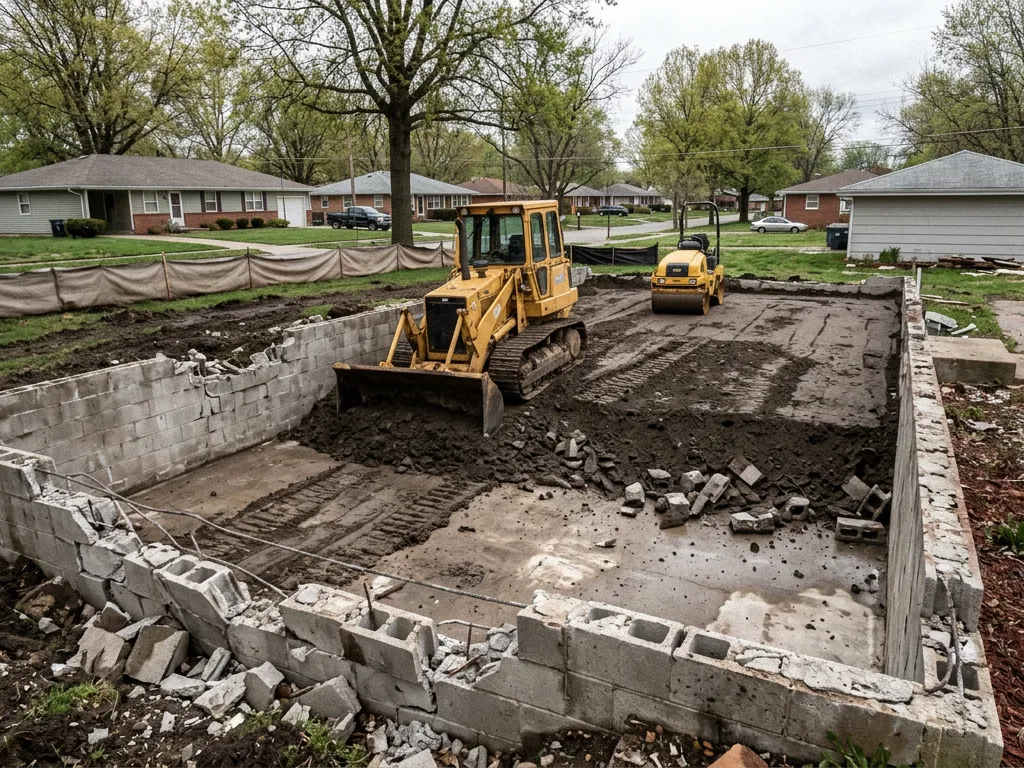
Filling the hole a house leaves
Independence Demolition Pros: Basement Fill-In in Independence, Missouri
The step after the house is gone: block or poured walls broken or removed, the slab cracked so water drains, several hundred yards of fill placed in lifts and compacted, and the lot graded to shed water.
- Independence and 10 towns within 20 miles
- Written price before any work starts
- City permit, utility and asbestos steps explained
- Local, licensed, insured contractors
Independence Demolition Pros connects Independence owners with local contractors for basement fill-in, the part of a teardown that decides whether the lot is usable in five years. Most houses in the city sit on full basements, which is why the local demolition range runs above the national average, and why a quote that says "fill the basement" without saying how is not finished.
Dumping a basement full of fill in one afternoon saves perhaps $1,500 in compaction and hauling and leaves a hole that settles for a decade; digging it back out to put a slab or a house on it later runs $5,000 to $10,000 before anything new is poured.
What it costs
$5,000 to $25,000
The published national range for basement removal and fill (Fixr). It is usually priced inside a house demolition rather than alone. A small block basement with walls broken in and clean fill sits near the bottom; a large poured basement with the walls hauled out and engineered fill compacted for a new structure sits near the top.
Calls answered Monday to Friday 7 a.m. to 6 p.m., Saturday 8 a.m. to 2 p.m.
Basements that need filling
- An open basement left by a fire, a storm or a teardown that stopped at the walls
- A sunken lawn over an old basement that was filled without compaction
- A lot being sold or built on where the lender wants the fill documented
- Standing water in an old foundation after every rain
What a proper fill-in involves
The walls are broken or pulled. For a lawn, block and poured walls are knocked in to well below grade and the rubble is buried at the bottom; for a building lot, the walls and footings come out. The slab is cracked in a grid so it cannot hold water. Then clean fill, usually clay from a nearby excavation or crushed concrete, goes in about a foot at a time, and each lift is run over with a compactor before the next. The surface is crowned, graded to drain away from the neighbors, and seeded.
- Volume
- A 1,000 sq ft basement 7 ft deep is roughly 260 cubic yards, about 20 to 25 truckloads
- Fill
- Clean clay or crushed concrete, compacted in lifts
- Inspection
- Kansas City inspects the basement and sewer before the hole is filled
Why one pour fails on Independence clay
The silty clay loams under Independence drain slowly and hold water. Fill dropped in one pour has air in it, and as it wets and dries it consolidates, so the surface sinks, ponds, and sinks more. Water that gets into an unbroken slab or behind standing walls stays there. Lifts and compaction take an extra day of machine time and are the difference between a lot that stays flat and one that becomes a pond.
Hole in the ground waiting on fill?
Say how big the basement is, whether the walls are still standing, and whether anything is being built on the lot. A local contractor prices the breaking, the fill and the compaction in writing.
Call (816) 846-2347Fill for a lawn or fill for a building
If a house is going on the lot, the fill is a structural question. The new foundation either goes to undisturbed ground below the old basement or sits on engineered fill placed and tested to a specification, and the builder or an engineer says which. The crews we work with price both and will tell you when the cheaper one is the wrong one. A simple lawn fill is enough for a yard, a garden or a parking area.
Fill-ins in the towns around Independence
Liberty requires basements removed to 18 inches below grade and the rest broken to eight-inch pieces before filling, so a Liberty fill-in is a larger job. Where only the foundation is left and the house is long gone, see foundation removal.
Basement Fill-In available in
Frequently asked questions
What owners ask before a teardown
How much does it cost to fill in a basement in Independence?
The published national range is $5,000 to $25,000, usually priced inside the house demolition. A small block basement with clean fill sits near the bottom; a large poured basement with engineered fill for a new structure sits near the top.
How much fill does a basement take?
A 1,000 square foot basement seven feet deep is about 260 cubic yards, roughly 20 to 25 tandem dump truck loads.
What are the signs a basement was filled badly?
A sunken rectangle in the lawn, ponding after rain, and cracks in anything poured over it. The fix is to dig it out and recompact.
Can crushed concrete from the house be used as fill?
Clean, broken concrete is often placed at the bottom of the hole and topped with soil, which saves hauling. Wood, drywall and roofing never go in the hole.
Does the City inspect the fill?
Kansas City inspects the basement and sewer before the excavation is filled. Independence inspects the sewer kill and erosion control; ask the contractor whether a compaction test is wanted if a building is planned.